The Chaldean Letter Table, and Why No Letter Is 9
The “Chaldean” table behaves like Hebrew gematria carried over into English letters and reduced to one digit. Every letter except X can be paired with a Hebrew letter whose standard value reduces to the same number. No letter takes 9 because the Hebrew letters worth 9 and 90, Tet and Tsadi, have no English letter of their own in that pairing.
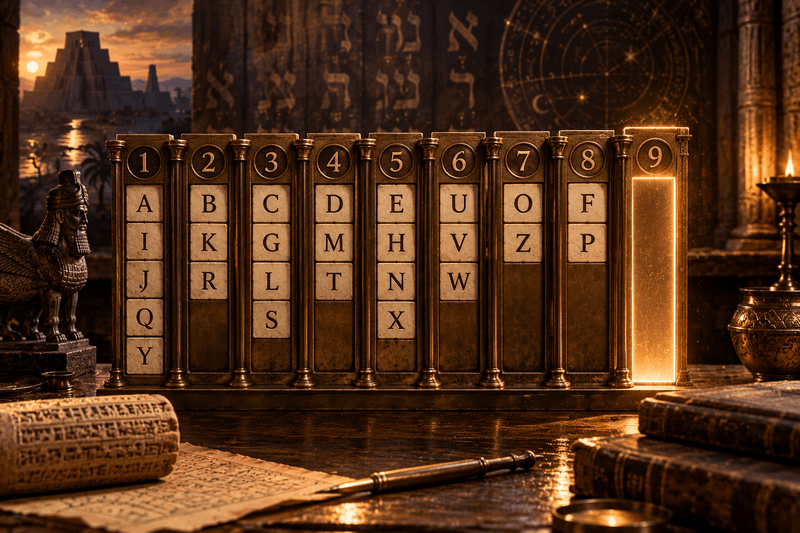
The pairing is this article’s check, not a method Cheiro states. It is set out below so it can be verified letter by letter.
The table against Hebrew values
Cheiro himself calls it the “ancient Chaldean and Hebrew alphabet” and says it is “believed” to have passed from the Chaldeans to the Hebrews (p.70). He introduces it as the way to find a person’s lucky day.
Hebrew values are the standard ones (Gematria); each reduces to a single digit (Kaf 20 → 2, Shin 300 → 3).
| Number | Chaldean letters | Hebrew letters of that root value | Fit |
|---|---|---|---|
| 1 | A I J Q Y | Aleph 1, Yod 10, Qof 100 | All fit: A = Aleph, I J Y = Yod, Q = Qof |
| 2 | B K R | Bet 2, Kaf 20, Resh 200 | All fit |
| 3 | C G L S | Gimel 3, Lamed 30, Shin 300 | All fit, reading C as Gimel |
| 4 | D M T | Dalet 4, Mem 40, Tav 400 | All fit |
| 5 | E H N X | He 5, Nun 50 | E and H fit He, N fits Nun; X has no partner |
| 6 | U V W | Vav 6, Samekh 60 | U V W fit Vav; Samekh unused |
| 7 | O Z | Zayin 7, Ayin 70 | All fit |
| 8 | F P | Het 8, Pe 80 | F P fit Pe; Het unused |
| 9 | none | Tet 9, Tsadi 90 | No English letter |
Three things stand out
- X is the one misfit. Samekh (60, root 6) is the natural partner for X, which would put X under 6.
- Sepharial’s 1920 “Hebraic” table follows the gematria more strictly. It puts X under 6 (Samekh), H under 8 (Het), and gives 9 to Th and Tz, the sounds of Tet and Tsadi (see the opening article).
- The modern table differs from Sepharial at exactly those points. It puts H and X under 5 and leaves 9 empty.
Why no letter is 9
Two explanations are on offer, and they do not conflict.
- Cheiro’s reason (pp.70–71): 9 stands for “the 9-lettered name of God”, so no single letter is given it. Indian handouts repeat the sacred-9 reason and list Mars, ruler of 9, with no letters (Aleka Ghose notes, in this series’ source files).
- The structural reasononly Tet (9) and Tsadi (90) reduce to 9 among the 22 Hebrew letters. Once T is given to Tav, neither has an English letter left, so 9 stays empty.
An empty 9 among the letters does not keep 9 out of the readings. Names still total 9, 18, 27 and so on, and those totals are read like any other.
Against the Pythagorean table
The Pythagorean table is alphabet position reduced to one digit; the Chaldean is Hebrew value by sound. They agree on 10 of 26 letters: A B C D E J K L M N.
| Number | Pythagorean (Phillips, 1980) | Chaldean |
|---|---|---|
| 1 | A J S | A I J Q Y |
| 2 | B K T | B K R |
| 3 | C L U | C G L S |
| 4 | D M V | D M T |
| 5 | E N W | E H N X |
| 6 | F O X | U V W |
| 7 | G P Y | O Z |
| 8 | H Q Z | F P |
| 9 | I R | none |
Pythagorean column from David A. Phillips, Secrets of the Inner Self (Angus & Robertson, 1980), Stage 12. The agreement on A to E follows from both alphabets keeping the Aleph–Bet–Gimel–Dalet–He order.
Cheiro dismissed the Pythagorean school as complicated by later followers, and presented his own as the original system (pp.115–117). Phillips, writing for the Pythagorean side, says the Chaldean system keeps its date-derived ruling number to 1 to 9, without his 10, 11 and 22/4.
Cheiro, Indian practice, and spelling
Cheiro and Indian practice use the same table; the difference is only in what they read from it, taken up in the two name-correction articles, in Cheiro’s text and in modern Indian practice.
- Indian practice applies Cheiro’s values unchanged. One Indian handout in this series’ source files works KRISHNA as K2 R2 I1 S3 H5 N5 A1 = 19, which only holds with the Chaldean H = 5.
- Every written letter counts. Cheiro’s table has no values for sounds such as Sh or Th, so a digraph adds both letters. Cheiro counts the T and H of SMITH separately: S3 M4 I1 T4 H5 = 17 (p.87). Sepharial’s Th, Tz and Ph values are not used.
- Spelling decides the number. RAHUL is 2 + 1 + 5 + 6 + 3 = 17; RAAHUL, a spelling cited in Indian name-correction practice (ezyLegal), is 18.
VedaJyoti rule: names are calculated from their English spelling, letter by letter, as the person writes it.
Sources
- Gematria, Wikipedia: standard Hebrew letter values.
- Cheiro, Cheiro’s Book of Numbers, Complete Edition, Revised (D. B. Taraporevala, Bombay; 1977 printing): the table and his reasons, pp.70–71, 87, 115–117.
- Living in Cycles blog, Parts 1 and 2 (2019–2020; copies in this series’ source files), as secondary reading.
- Sepharial, The Kabala of Numbers, scan dated 1920: the “Hebraic” table, read from OCR.
- David A. Phillips, Secrets of the Inner Self, Angus & Robertson, 1980 (copy in this series’ source files).
- Aleka Ghose notes and the Astrogle numerology handout, in this series’ source files: Indian use of the table.
- ezyLegal: spelling changes in Indian practice.