Name Correction in Modern Indian Practice
Modern Indian correction does not aim at a root number. It aims at a short list of compounds, labelled by planet and chosen for the person’s birth number and full-date number together. Measured against Cheiro’s own compound list, those lists are mostly consistent: they leave out 28, for example. But some prescribed targets carry an unfavourable reading in Cheiro, and many lie above 52, where his list ends. The planet labels are mixed as well. The handout that calls 7 Ketu still prescribes it as Neptune, and no planet-numbers list is given for 4, Rahu, or for 8, Saturn.
How a prescription is built
The working text here is the Astrogle handout in this series’ source files. It has one entry for each pair of birth number and fadic (full-date) number. Each entry has the same four-part structure:
- 01Planet diagnosis. The pair is assigned to its planets. Example: 4/4 is “under the full influence of Rahu”.
- 02The cost of a wrong name. An unsuitable name brings named harms, from marriage and money to health. Some entries say diseases “can be cured” if the name is amended.
- 03The naming method. The entry names one to three planets whose compounds the name should total.
- 04Tips. Lucky dates, stones and colours, with unsuitable dates. For a 4 birth number these are 8, 17 and 26.
Two more layers sit on top of this in the handout’s KP section:
- The name total includes everything used. That means “initials, and other customarily used titles”. It produces a single figure, not one per setting as in Cheiro.
- The sounds are tested against the horoscope. The first and last syllables (akshara) of the name should vibrate favourably with the benefic points of the chart. Those points come from KP sub-lords of the ascendant, the Moon, Fortuna and the 3rd, 5th and 11th cusps. Planets are mapped to Sanskrit syllables after Chathura Sundari.
The second layer is not numerology in Cheiro’s sense at all. It ties the name to a cast chart. A correction made this way cannot be checked without the chart.
The target lists, checked against Cheiro
The table collects every planet list the Astrogle handout prescribes, across all its entries. Each is set against Cheiro’s compound list as printed in his Chapter XIII (pp.80–85). In that list, numbers without their own meaning borrow from the nearest lower number in the same series. The readings used below are 28 (p.83), 29, 38 and 47 (pp.83–85), 43 (p.84), and 15 with its 4-or-8 warning (pp.80–81).
| Label (root) | Numbers prescribed | Cheiro’s reading |
|---|---|---|
| Sun (1) | 10, 19, 37, 46, 64; sometimes 73, 82; once 55. One entry says “avoid 28”. | 10, 19 and 37 are fortunate; 46 reads as 37. 55 and above are beyond his list. 28 means loss through trust in others. |
| Jupiter (3) | 21, 39; once 21, 30, 48 | 21 is fortunate. 30, 39 and 48 are “neither fortunate nor unfortunate”. |
| Mercury (5) | 14, 23, 32, 41, 50, 59, 77; sometimes 5 | 23 is fortunate. 32 is fortunate if the person holds to their own judgment, and 41 and 50 read as 32. 14 favours money, with risk. 59 and 77 are beyond his list. |
| Venus (6) | 15, 24, 33, 42, 69, plus 51 or 60 or both, depending on the entry; sometimes 6 | 24 is fortunate; 33 and 42 read as 24. 15 is fortunate for money but carries a warning when tied to 4 or 8. 51 brings sudden advancement but threatens enemies. 60 and 69 are beyond his list. |
| Mars (9) | 27, 36, 45 | 27 is the Sceptre, a good number; 36 and 45 read as 27. |
| Moon (2) | 38, 47 (two entries for birth number 7) | Both read as 29: “not a fortunate number”. |
| Neptune (7) | 34, 43 (entries for birth number 2) | 34 reads as 25: success after strife. 43 is “an unfortunate number”. |
| Rahu (4), Ketu (7), Saturn (8) | None prescribed | Not applicable |
Three results for an expert reader.
- Most targets are good numbers in Cheiro’s list, and the one explicit exclusion, 28, follows his reading. The lists look derived from his compounds, not independent of them.
- Some targets are bad numbers in Cheiro’s own terms. 38 and 47 (Moon) and 43 (Neptune) are prescribed as lucky. Cheiro reads them as unfortunate. The 4/4 entry also prescribes 15. Cheiro warns of that compound in exactly the 4 and 8 case.
- Cheiro’s planet pairings outlast the Rahu and Ketu relabelling. Birth number 2 is sent to Neptune numbers and birth number 7 to Moon numbers. That is Cheiro’s own 2–7 pairing (pp.40, 56), kept under his own planet name; he groups 1, 2, 4 and 7 together as one interchangeable family (planets article). The nodes, and Saturn, never appear as targets.
One agreement is worth noting: the KP table’s 5 for an 8 birth number matches Cheiro’s own later rule of “1, 3, 5, or 6” (pp.91, 132, 134).
The lists are not stable across entries. Venus appears with and without 51 and 60. The Sun list ends at 64, 73 or 82. Read the handout entry by entry; a single consistent list cannot be taken from it.
What is claimed, and the objections
The claims are wider than Cheiro’s. The Astrogle handout says a name that agrees with the “Corporal and Vital Numbers” brings “health, wealth, life partner and children”. It also says some diseases can be cured by amending the name. Aleka Ghose’s handout says numerology remedies can rectify “planetary defects” in a birth chart. It calls the effect of a numerologist’s spelling change “stupendous”. Cheiro’s own promise, in the 4–8 passage, is material success and a change from a lonely, unlucky life. That is broad, and Cheiro does make health claims: Chapter XXVIII lists diseases, the months to guard against and herbal remedies by birth number (pp.140–145). But he ties them to the birth number, never to a name change, and he makes no claim about repairing a horoscope.
The press reports the practice with a caveat. India TV’s June 2026 piece on Arviend Sud’s naming rules ends with a disclaimer: the advice rests on belief and tradition, and there is no scientific evidence for it.
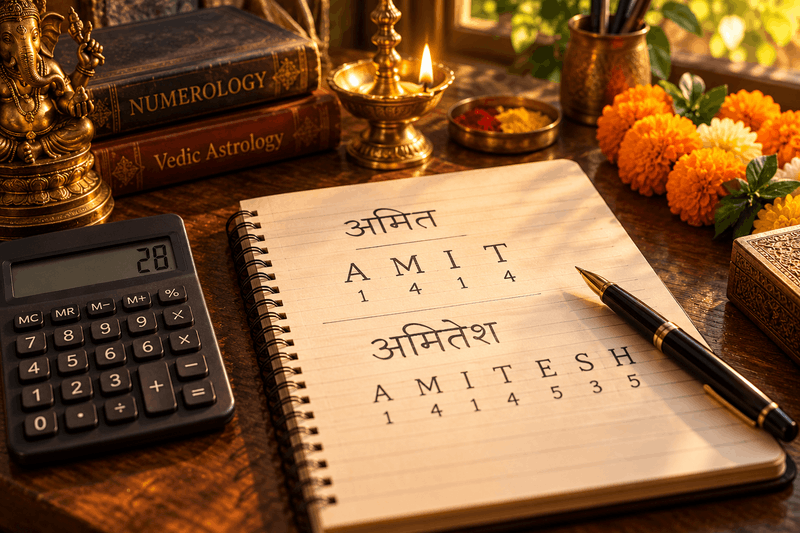
The sharpest objection concerns the script. A 2017 essay in The Diplomat catalogues spelling changes credited to numerologists in Indian public life, made by doubling or dropping letters. It objects to counting Latin letters for names written in Indic scripts, where vowels attach to consonants. It also notes that the count ignores pronunciation, and that it is applied selectively, for example by leaving out a middle name.
That objection lands directly on this series’ house rule of always using English spelling. The rule makes readings repeatable. It also means the number belongs to the romanised name, not to the name as written in Devanagari or any other Indic script, and not to the name as spoken. A reading should say so whenever the person’s name has a native-script form.
How this series presents a correction
- 01The Indian target is cited in full. That means the source, the entry (birth number / fadic number) and the exact list of numbers in that entry, not a merged list.
- 02Each target is checked against Cheiro. Where Cheiro reads a prescribed compound as unfavourable (38, 43 and 47), or as a warning in that case (15 for 4 or 8), the reading says so. A target above 52 is marked as having no Cheiro entry.
- 03Cheiro’s verdict sits alongside. As the article on Cheiro’s own text sets out, he advises a change in every case where the name and birth numbers disagree, except some 4 and 8 cases (p.93). What differs from Indian practice is the target — a root number, not a listed compound — not how often he changes a name.
- 04The script and pronunciation are noted. The number belongs to the English spelling under house rule 3.
- 05No claim is passed on about health, a cure or repairing a chart. Those claims belong to the handouts. They are reported as their claims and not adopted.
- 06A correction that depends on chart sub-lords (the KP method) is marked as a Jyotish procedure. It is outside this numerology series.
Sources and open checks
Sources
- Astrogle numerology handout, in this series’ source files, for:
- its KP section
- its combination entries and naming methods
- the Neptune numbers
- the Moon numbers
- the “avoid 28” instruction
- the 4/4 entry
- the health, wealth, partner and children claim
- the claim that diseases can be cured
- Cheiro, Cheiro’s Book of Numbers, Complete Edition, Revised (D. B. Taraporevala, Bombay; 1977 printing): the compounds 10–52 in Chapter XIII (pp.80–85), the 4-and-8 name rule (pp.91, 132, 134) and the disease chapter (pp.140–145). The compounds are discussed in the compound numbers article.
- Aleka Ghose, Decoding the science of numbers (Eekaparnika), in this series’ source files.
- India TV, 1 June 2026.
- The Diplomat, October 2017. The author’s name was not shown in the fetched text.
Open checks
- The Astrogle handout’s authorship and date are unknown. Some headings and numbers are damaged in the OCR (“IS” for 15, “12” where 42 or 32 is expected). The tables above use only numbers that read cleanly in at least one entry.
- Whether other Indian schools prescribe Rahu, Ketu or Saturn compounds as targets has not been surveyed. The absence noted here holds for this handout only.