The Planets Behind the Numbers, and Where Numerology and Jyotish Disagree
The conflict is built into the history. Cheiro made 4 the Sun’s second number and 7 the Moon’s, so in numerology 1 sits with 4 and 2 with 7. Indian compatibility lists still pair 4 with 1 and 7 with 1 and 2, but call 4 and 7 Rahu and Ketu, and in Jyotish the nodes are enemies of the Sun and Moon. One Indian handout in this series’ source files states both positions on the same page.
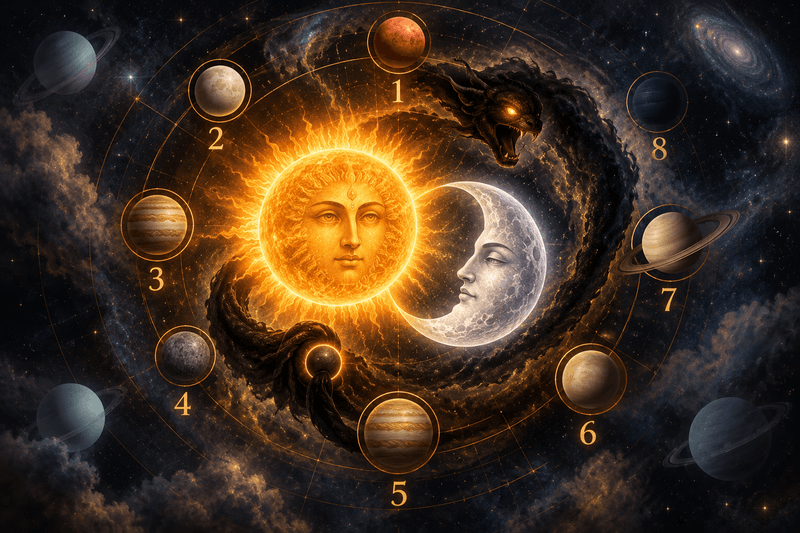
Cheiro’s planets and the Indian reassignment
| Number | Cheiro, Book of Numbers (pp.22, 33) | Heydon, via Sepharial (1920) | Indian practice |
|---|---|---|---|
| 1 | Sun (written 1–4) | Sun 1 positive | Sun |
| 2 | Moon (written 2–7) | Moon 2 negative | Moon |
| 3 | Jupiter | Jupiter | Jupiter |
| 4 | Uranus, linked to the Sun | Sun 4 negative | Rahu |
| 5 | Mercury | Mercury | Mercury |
| 6 | Venus | Venus | Venus |
| 7 | Neptune, linked to the Moon | Moon 7 positive | Ketu |
| 8 | Saturn | Saturn | Saturn |
| 9 | Mars | Mars | Mars |
Three layers sit on the same numbers. Heydon’s 4 and 7 are the Sun and Moon themselves. Cheiro hands them to Uranus and Neptune but keeps the link to the Sun and Moon. Indian practice replaces them with the nodes (Free Press Journal, May 2026); the handouts in this series’ source files still mention Uranus and Neptune as an alternative.
The conflicts, pair by pair
In Cheiro, 1, 2, 4 and 7 form one family: 1 with 2, 4, 7 (p.38); 2 with 1, 4, 7 (p.40); 4 with 1, 2, 7 (p.47); 7 with 1, 2, 4 (p.56). Jyotish makes the nodes hostile to both lights, so the conflict covers all four pairs, not two.
The Indian side here is the Astrogle handout in this series’ source files. It gives each number a profile list (friendship, business, romance, marriage) and, separately, an interaction table for every pair. The Jyotish side is natural friendship (naisargika maitri). On onlinejyotish, the Sun’s friends are Moon, Mars and Jupiter, and the Moon has no enemies. Neither list names the nodes. On vedicmarga, Rahu’s enemies are Sun, Moon and Mars, and Ketu’s are Sun and Moon. So the hostility runs from the nodes to the lights, not back.
| Pair | Cheiro’s lineage | Astrogle handout | Jyotish | Verdict |
|---|---|---|---|---|
| 1 and 4 | One planet: the Sun, written 1–4 | 4’s lists put 1 under friendship, romance (“1 best”) and marriage. Both interaction tables call the pair compatible in marriage. | Rahu counts the Sun as an enemy | Direct conflict |
| 2 and 7 | One planet: the Moon, written 2–7 | 7’s lists put 2 under business, romance and marriage. 7’s table says not ideal for marriage. 2’s table says compatible but not ideal, and good for business. | Ketu counts the Moon as an enemy | The lists conflict with Jyotish. The tables partly agree with it, and with each other only on marriage. |
| 1 and 7 | Interchangeable: 7 is among 1’s numbers (p.38), and 1 among 7’s (p.56) | 7’s lists give friendship 1, 7. 7’s table calls the pair compatible in marriage. 1’s table: friendship beneficial, marriage not recommended. | Ketu counts the Sun as an enemy | The handout disagrees with itself; one side matches Jyotish |
| 2 and 4 | Interchangeable: Cheiro lists 4 among 2’s interchangeable numbers (p.40), and 2 among 4’s (p.47) | 4’s lists leave 2 out of all four. 4’s table: not compatible in marriage. 2’s table: good for marriage. | Rahu counts the Moon as an enemy | 4’s side matches Jyotish; 2’s side does not |
The weekday lists show the same thing. The handout’s best day for 4 is Sunday. For 7 it is Sunday and Monday. They are Cheiro’s own days: for 4, Saturday, Sunday and Monday (p.47); for 7, Sunday and Monday (p.56). The handout copies them exactly. The handout uses the node names, but its days and its strongest pairings still follow the Sun and Moon. It also gives Ketu’s enemies as Sun, Moon and Mars, where vedicmarga makes Mars a friend of Ketu. Both name the Sun and Moon.
How this series handles it
The house rule is that numerology is the frame and conflicts are named, not settled. In practice:
- Readings use the Cheiro lineage for number relationships. 1, 2, 4 and 7 are read as one interchangeable group, as Cheiro does (pp.38–56).
- The node label comes with a flag. Whenever 4 or 7 meets 1 or 2, the reading says that in Jyotish the node is hostile to that light. It does not pick a side.
- The handout’s own splits are reported, not smoothed over. Where the profile list and an interaction table disagree (2 with 7, 1 with 7, 2 with 4), both are cited.
- A chart outranks a bare number on Jyotish questions. Natural friendship is a relationship between planets placed in a horoscope. Whether it carries over to day numbers is the open question. This series has not found a source that argues it either way.
The last point is the real dispute for an expert reader. The Indian reassignment took the names Rahu and Ketu but kept Cheiro’s affinities: same days, same favoured partners. A practitioner who reads 4 as Rahu in full (enmity included) and one who reads it only as a label will give opposite advice for a 1–4 marriage. They will each be applying one half of the inherited system correctly.
Sources and open checks
Sources
- Cheiro, Cheiro’s Book of Numbers, Complete Edition, Revised (D. B. Taraporevala, Bombay; 1977 printing): the planets and weekdays (p.33); the Sun as 1–4 with Uranus and the Moon as 2–7 with Neptune, Uranus called “feminine” and Neptune “masculine” (p.22); the interchangeable numbers (pp.38, 40, 46–47, 56).
- Sindy, “Investigating Correspondences Between Numerology and Astrology Part 2”, Living in Cycles, 21 January 2020. It reports the nodes in Indian use. The weekdays, and Uranus and Neptune as the mental sides of the Sun and Moon, are now cited to the book instead.
- Sepharial, The Kabala of Numbers (1920), for Heydon’s positive and negative numbers. Read from OCR.
- Astrogle numerology handout, in this series’ source files, for:
- its ruling planets, with “some say Uranus” and “Neptune”
- Ketu’s friends and enemies
- its profile lists for 4 and 7
- its interaction tables for 1, 2, 4 and 7
- Free Press Journal, May 2026, and Outlook India, April 2026, for current Indian use of the nodes as number rulers.
- onlinejyotish, lesson 5: friendships of the Sun and Moon.
- vedicmarga: friendships of Rahu and Ketu. Its own caveat is that interpretations vary among astrologers.
Open checks
- Heydon’s Holy Guide has not been read directly. His numbers come through Sepharial.
- Neither Jyotish source names a classical text for the node friendships. The table should be checked against a named classical text before it is treated as more than a common modern listing.
- No source checked explains who first replaced Uranus and Neptune with Rahu and Ketu, or when.