A Handful of Flattened Rice
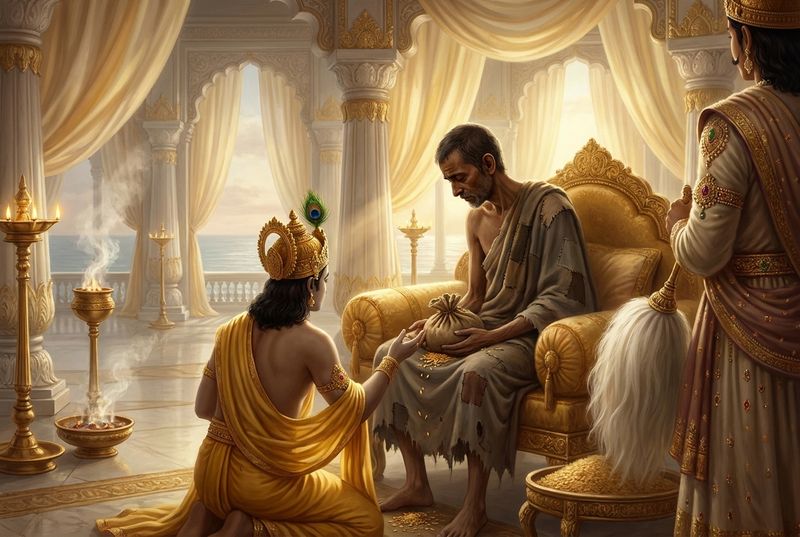
The tenth book of the Bhagavata Purana tells of a poor brahmana, known in tradition as Sudama, who went to see his old friend Krishna with nothing to give but four handfuls of flattened rice.
Two boys at the guru's house
Long before, the two had studied together in the house of the sage Sandipani. Once the guru's wife sent the boys into the forest for firewood. A storm broke, the forest flooded and went dark, and they were lost all night, until their teacher came looking for them at sunrise.
Krishna became king at Dvaraka. His friend became a householder: learned, peaceful and detached, living on whatever came to him unasked. He and his wife were poor. His clothes were worn, and he was so thin his veins showed.
The gift
His wife urged him to go to Krishna, who was kind to brahmanas and could give them shelter. He agreed, though not for wealth: seeing the Lord, he reasoned, was the greatest gain a life could have. For a gift, she begged four handfuls of flattened rice from the neighbours and tied them in a torn cloth.
At Dvaraka he passed the guard posts and the gateways and came to the palace. Krishna rose from his bed, embraced his friend and wept. He seated him, washed his feet and sprinkled the water on his own head, and honoured him with sandalwood, incense and lamps, while the goddess of fortune herself fanned the guest. Then the two talked of their schooldays.
The handful
Krishna asked what his friend had brought from home, and spoke the words the Bhagavad Gita also gives him:
patraṁ puṣpaṁ phalaṁ toyaṁ yo me bhaktyā prayacchati
tad ahaṁ bhakty-upahṛtam aśnāmi prayatātmanaḥ
In plain English: "Whoever offers me with devotion a leaf, a flower, a fruit or water, I accept that offering of love from a pure heart, and I eat it."
Too ashamed to offer his bundle, the brahmana kept it hidden and his head bowed. Krishna knew why he had come. He pulled the rice out of the old cloth himself, said it would satisfy the whole universe, and ate a handful. As he reached for a second, Rukmini took his hand. One handful, she said, was enough to secure the giver's prosperity.
Home
The brahmana spent the night in the palace and set off in the morning without having asked for anything, and without being given anything he could see. When he reached home, he found towering palaces and gardens where his house had stood, and his wife coming out to meet him adorned with jewels.
He knew whose mercy it was. He had never begged, yet the Lord had given him abundant riches. He lived among them without attachment, and never forgot their giver.
The meal offered every morning
Balabhogam is a food offering made to the Lord early each day, before the day's other offerings. The brahmana's story is the best-known telling of what such an offering means to the one who receives it: the Lord looks at the love, not at the size of the gift.
At Yadagirigutta the offering goes to Lord Lakshmi Narasimha. Krishna and Narasimha are both avatars of Vishnu, and the Narasimha avatar is told in The Narasimha Avatar: A Boon, a Pillar and a Doorway.
Tradition and record
The story is record: it stands in the Bhagavata Purana, book ten, chapters 80 and 81, and the verse Krishna speaks there also stands in the Bhagavad Gita, chapter 9, verse 26. In the verses themselves the brahmana is not named; the name Sudama, by which he is widely known, comes from tradition and later editions. The English renderings in this article are paraphrases. The Bhagavata does not mention Balabhogam; the link between the story and the temple's morning offering is ours.