The King Who Kept Ekadashi
The ninth book of the Bhagavata Purana tells of King Ambarisha, who kept the Ekadashi vow, and of what happened when he broke his fast.
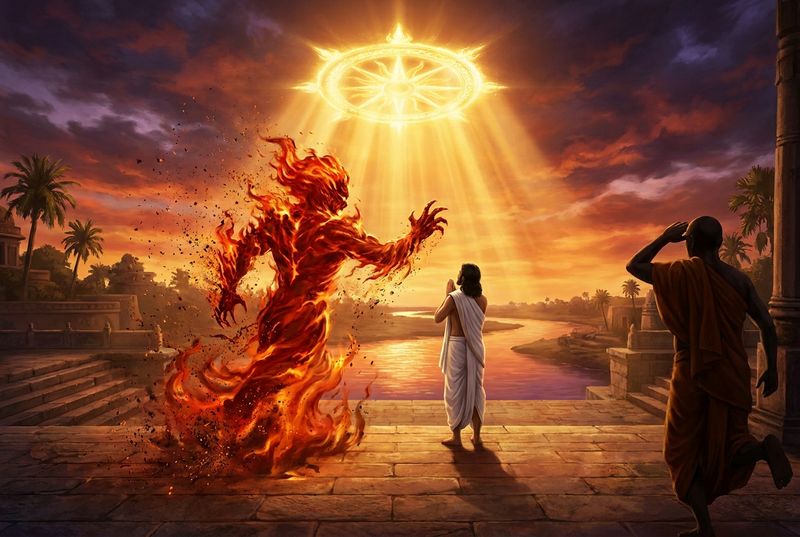
A king who wanted nothing
Ambarisha was a king who wanted nothing for himself. He gave up attachment to his family, his wealth and his possessions, and put every sense to work for the Lord: his mind on the Lord's feet, his words in praising him, his hands in cleaning his temple, his ears in hearing of him, his eyes in seeing his form.
With his queen, Ambarisha kept the vow of Ekadashi and Dvadashi, the eleventh and twelfth lunar days, for a whole year. At the end of it he worshipped the Lord, fed the brahmanas and gave away cows. Then, on Dvadashi, he sat down to break his fast.
The guest
At that moment the great sage Durvasa arrived, uninvited. The king received him with honour and asked him to eat. Durvasa accepted, but first went to the river Yamuna to bathe and perform his rites.
He was slow to return. Only a short time of Dvadashi remained, and the fast had to be broken within it. If the king ate before his guest, he would offend the sage. If he did not eat, he would break his vow.
Ambarisha asked the learned brahmanas what to do. He decided to drink a little water: drinking water, they held, may be taken as eating and as not eating. So he kept his vow and did not insult his guest.
The sage's anger
Durvasa knew at once, by his powers, what the king had done. Furious, he pulled out a lock of his hair and from it created a demon, blazing like the fire at the end of the world, and sent it against the king.
The demon could not touch Ambarisha. The Lord had already ordered his discus, the Sudarshana chakra, to protect his devotee. The discus burned the demon to ashes, then turned on Durvasa himself.
The flight
Durvasa fled, and the fire of the discus followed him wherever he went. He ran to Brahma, who could not shelter him. He ran to Shiva, who could not shelter him. He ran at last to the Lord himself, Narayana, and begged for protection.
The Lord would not excuse an offence against his devotee. He was, he said, under the control of his devotees. Power used against a devotee harms the one who uses it. Go to the king, he told Durvasa, and ask his pardon.
The king's prayer
Durvasa came back and fell at Ambarisha's feet. The king prayed to the discus itself, calling it fire, sun and moon, and asked it to give the sage shelter and be kind to him. The discus grew peaceful and stopped burning.
Freed, Durvasa praised the king: today, he said, he had seen the greatness of the Lord's devotees. All the while he had been gone, Ambarisha had not eaten, living on water alone. Now he fed the sage with every kind of pure food, and only then ate himself.
The day and the discus
The story shows the Lord's care for a devotee who keeps his day. At Yadagirigutta, Ekadashi is the day of Laksha Pushparchana, and the Lord who receives the flowers is Narasimha, who came out of a pillar to protect another devotee, Prahlada. That story is told in The Narasimha Avatar: A Boon, a Pillar and a Doorway.
Tradition and record
The story is record: it stands in the Bhagavata Purana, book nine, chapters four and five, and anyone can read it there. The English renderings in this article are paraphrases. The Bhagavata does not mention Laksha Pushparchana; the link between Ambarisha's Ekadashi and the temple's Ekadashi worship is ours. The details of the worship at Yadagirigutta are as reported in the press, not from the temple's own published description.