The Nine Ways of Prahlada
The seventh book of the Bhagavata Purana tells the story of a boy who gave his father the wrong answer, and of what that answer set in motion. Archana is in that answer.
A prince at school
Hiranyakashipu, king of the daityas, was the sworn enemy of Vishnu. His son Prahlada was sent to be schooled by Shanda and Amarka, the sons of Shukracharya, preceptor of the daityas. They taught him statecraft: politics, economics, and how to divide the world into friends and enemies.
The boy listened, and did not agree. When his teachers questioned him, he gave the credit for his devotion to the Lord, and said no one had taught it to him. When they left the classroom, he taught it to his classmates.
The question
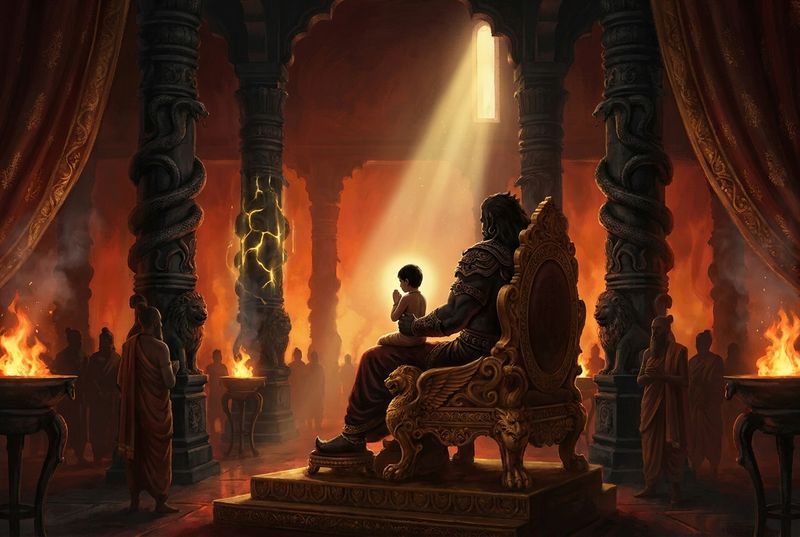
One day the king took his son on his lap and fondly asked him what was the best thing he had learned. Prahlada did not answer with his teachers' lessons. He named nine ways of devotion to Vishnu:
śravaṇaṁ kīrtanaṁ viṣṇoḥ smaraṇaṁ pāda-sevanam
arcanaṁ vandanaṁ dāsyaṁ sakhyam ātma-nivedanam
In plain English: hearing of Vishnu, singing of him, remembering him, serving his feet, worshipping him, bowing to him, serving him, befriending him, and giving oneself wholly to him. Whoever offers devotion to the Lord in these nine ways, Prahlada said, has learned the best there is.
The fifth of the nine is arcanam: worship of the Lord with offerings. It is the same word as the temple's archana.
What the answer cost
The king laughed at first, and blamed his enemies for spoiling the boy. Then he turned on the teachers and demanded to know who had taught his son such things. Shanda denied it.
Prahlada answered that devotion like his does not come from teachers who are themselves blind to it. At that, Hiranyakashipu threw his son from his lap and ordered his servants to kill him.
They struck him with tridents while he sat absorbed in the Lord, and he was unharmed. They tried elephants, snakes, poison, starvation, cold, fire, water, a fall from a hill and heavy stones. Nothing worked, and the king began to fear that his son could not die.
Where it ends
The story does not end in that chapter. It ends at a pillar, when the king demands to know where this Lord of his son's can be found, and Narasimha comes out of it. That part is told in The Narasimha Avatar: A Boon, a Pillar and a Doorway.
The archana and the boy
When a priest chants the Lord's names and offers flowers on a devotee's behalf, the devotee is keeping the fifth of Prahlada's nine ways. At Yadagirigutta, the Lord who receives it is the same Narasimha who came for Prahlada, here in his gentle form with Lakshmi.
Tradition and record
The verses are record: they stand in the Bhagavata Purana, book seven, chapter five, and anyone can read them there. The English renderings in this article are paraphrases, not a published translation. The link between Prahlada's arcanam and the temple's archana is the shared word and its place in devotional tradition; the Bhagavata does not describe temple archana as it is performed today.