The Five Forms of Yadagirigutta, One by One
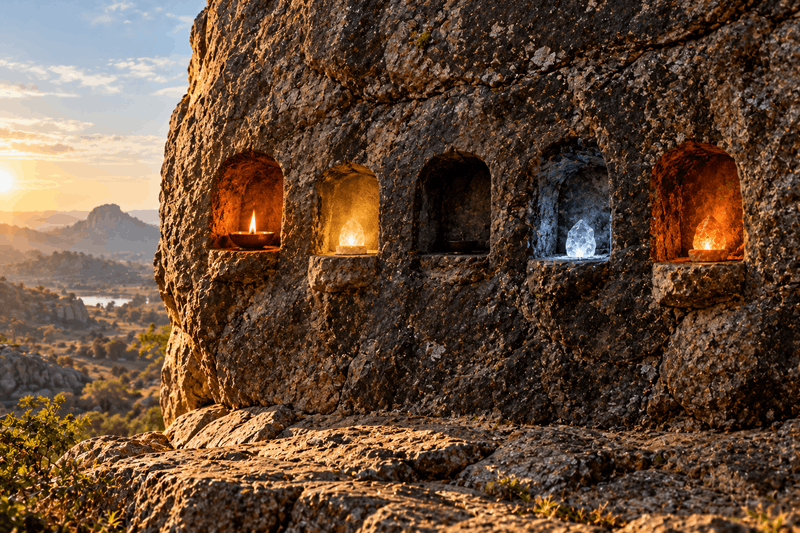
Five forms at one site is what makes this hill a kshetra rather than a shrine. Four of the five are ordinary enough in Narasimha iconography. The third is not, and it is the reason Yadagirigutta is not simply a smaller Ahobilam.
Every source lists the same five names: Jwala, Yogananda, Gandabherunda, Ugra and Lakshmi Narasimha. The order they are listed in varies by source, and so does which of them a devotee can actually see.
Before the five, two cautions
The first is about counting. Two Telugu pages list the five as Jwala, Yoga, Nanda, Gandabherunda and Narasimha — which looks very much like Yogananda split into two forms by a line break. Another site names only three forms inside, with two more self-manifested. Several sources call all five swayambhu rock formations rather than carved images.
The second is about the name. At Yadagirigutta, "Pancha Narasimha" means five forms at one site. Elsewhere in the Telugu country the same phrase means five separate temples — Vedadri, Vadapalli, Mattapalli, Mangalagiri and Ketavaram. The two usages are unrelated and are easily conflated.
One thing we could not get for any of the five: an agama-based iconographic description, with arm counts and postures. Nothing below rests on one.
Jwala
Standard iconography takes Jwala as the flame-emitting form. Here the tradition cannot quite decide between a flame and a serpent. Some sources describe a serpent shape in the rock; others a flame. One Telugu account resolves it by saying the serpent shares a chamber with Yogananda but cannot be physically seen at all, with the eternal flame in the sanctum standing as its sign, and that practitioners of the mantra are said to see the serpent-fire in meditation.
Whatever it is, it is agreed to be hard to look at. One blog calls Jwala "particularly difficult to observe"; another says he gives darshan between two stone plates.
Yogananda
Standard iconography shows a serene form teaching yoga. Here he sits in padmasana with his hands open on his knees, and he is the one form everybody can point to: the principal form in the cave, the one devotees meet in ritual, the reason they descend the stair at all.
Of the five, this is the one with the least disagreement attached to it.
Gandabherunda
This is the form that sets the site apart, because it is not among Ahobilam's nine — and Ahobilam is the benchmark. The Gandabherunda is a form of Vishnu depicted as a double-headed eagle, often shown holding elephants.
The story behind it is a sectarian argument conducted in mythology. Shaiva texts — the Shiva Purana, the Linga Purana, the Sharabha Upanishad — have Shiva take the Sharabha form to subdue Narasimha after the kill, in some versions wearing his hide afterwards. The Vaishnava answer is the two-headed bird, identified with Vishnu, who defeats Sharabha. In one account the battle lasts eighteen days and ends with the two exchanging skins. A popular essay attributes the story to the Narasimha Purana; the standard summary of that text does not confirm it.
Its royal career is much better documented than its shrine career. The oldest temple depiction is at Balligave in the eleventh century. It became Vijayanagara's coat of arms, then the Wodeyar emblem, and is now Karnataka's state emblem; Achyuta Deva Raya's gold coins were the first to carry it on coinage.
At Yadagirigutta, tradition places the form in a long gap in the rock just below Hanuman, to the right of the main door, where a sincere wish is believed to be granted. One source adds carved reliefs in the octagonal mandapa courtyard.
Two things are worth setting against that. In the four volumes of Epigraphia Telanganica the word "Gandabherunda" appears exactly once — as an epithet of the chief Kote Bhimarasa in 1067. It is a chief's title there, not a deity. And no source we reached attests Gandabherunda as a shrine form anywhere else in the Telugu country. At this hill it rests on temple tradition alone, which is precisely what makes it distinctive and precisely why it cannot be dated.
Ugra
Standard iconography takes Ugra as the fierce form that disembowels Hiranyakashipu. Here it is the least located of the five, and the sources are strikingly reluctant about it. The standard reference gives no description at all. One source alone says it is visible at the cave entrance. Another says the opposite — that it is invisible but present throughout the circumference of the hill, the form that repels destructive forces, and that the hill circuit is what invokes it. Two more treat it simply as the form that appeared first and frightened the sage into asking for a gentler one.
No source describes the faces or postures of Ugra in the sanctum. In the one telling where a woman's search finds the forms, she finds four; the fifth, this one, stays unseen.
Lakshmi Narasimha
The form the place is named for, and the one the whole legend bends towards. Lakshmi sits on his lap — on his left thigh, one source specifies — and he is serene, carrying chakra and conch. A silver Lakshmi Narasimha icon stands in the main shrine, and a larger image outside the sanctum, with silver deities in the cave itself.
One account adds a diamond-studded golden glove and a raised hand of blessing, and notes the by-name the Lord carries locally: Doctor God. That is the thread that runs out of iconography and into the healing lore, which is where it is picked up.
How the five sit against Ahobilam's nine
Ahobilam's upper shrines are Ahobila, Bhargava, Jvala, Yogananda, Chatravata, Karanja, Pavana, Malola and Varaha, with Prahladavarada below. Yadagirigutta shares Jwala, Yogananda and a fierce form with that list. Gandabherunda it does not share with Ahobilam or with anywhere else.
Vedadri is also described as enshrining five forms — Vira, Salagrama, Jwala, Lakshmi and Yoga Narasimha — so a five-form site is not unique in itself. The particular five here are.
Which of them appeared first, and in what order, is a question the sources answer four different ways.
Reckoning the days
The five forms stay where they are. The days on which each is honoured do not — they move against the Gregorian calendar every year, because they were never fixed to it.
Our panchang app, Navashi, computes that layer for any date and any place: tithi, nakshatra, yoga and karana, the day’s muhurats, choghadiya and hora, and the festival calendar with start and end timings rather than a single date. It carries eight traditions, not one.
- iPhone and iPadNavashi on the App Store
- AndroidNavashi on Google Play