The Legend of Yadarishi, and the Seven Ways It Is Told
The temple's own account of itself is a single clean story. Set the sources side by side and it becomes seven stories wearing one name.
Neither observation is a debunking. A sthala purana is a living thing and variation is what living things do. But the variation is interesting in its own right, and it is almost never shown, so it is shown here.
The story as most sources tell it
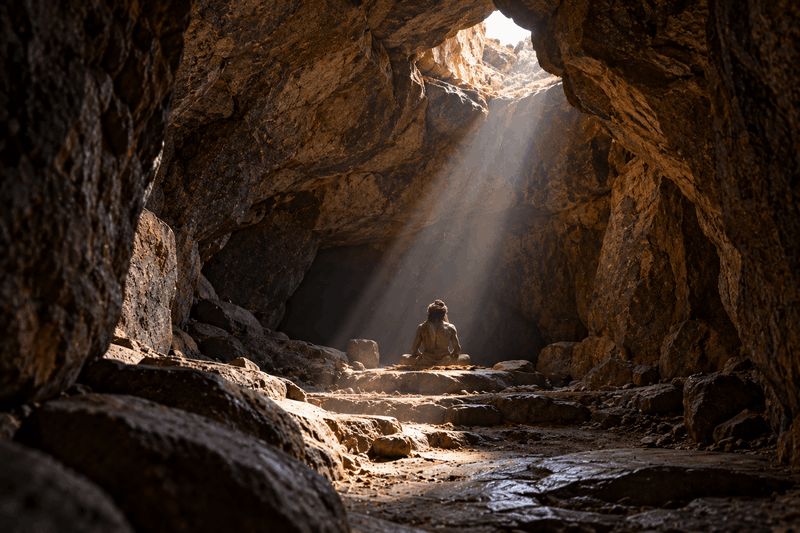
Tradition says that in the Treta Yuga there lived a sage named Yada, called Yadarishi or Yada Maharshi, son of the great sage Rishyasringa and of Shanta Devi. He wished to see Lakshmi Narasimha face to face. He performed severe penance in a cave on this hill, with the blessings of Anjaneya, Hanuman.
Pleased with the penance, Sriman Narayana sent Anjaneya to direct the sage to a holy spot, and there the Lord appeared to him as Lakshmi Narasimha. The sage saw him in five forms — Jwala, Yogananda, Gandabherunda, Ugra and Lakshmi Narasimha — and the five, in the oldest English temple-lore wording we have, "manifested themselves into finely sculpted forms" in the rock. The hill then took the sage's name: Yada, with the Sanskrit giri or the Telugu gutta for hill.
Two things that story does not say are worth stating plainly. No source we could read gives a number of years for the penance. And none describes the sage's death or departure, beyond one telling in which the Lord grants him moksha once the five forms have appeared.
One more thing follows from it. Every telling that explains the hill's name derives it from the sage, which makes it the temple's own explanation rather than an independent one. The single outside gloss we found, in a national news magazine, simply calls "Yadagiri" another name for Narasimha and never mentions a sage at all.
The epics name the parents, and no son
The legend's claim on the Ramayana is specific: this sage was the child of Rishyasringa and Shanta. The standard texts supply both parents in detail and no such child.
In the Valmiki Ramayana, Rishyasringa is the son of Vibhandaka and grandson of Kashyapa, raised in forest seclusion and ignorant of the world. King Romapada's land of Anga suffers a drought; courtesans lure the young ascetic to the court; rain returns; and Romapada gives him his daughter Shanta. Sumantra later recounts to Dasharatha the prophecy of four sons, Rishyasringa agrees to travel to Ayodhya, and he conducts the putrakameshti — the sacrifice through which Vishnu agrees to be born as Dasharatha's son.
The Mahabharata agrees on the outline in its Vana Parva, adds that his mother was a celestial hind, calls the king Lomapada, and says the drought followed his deception of a Brahmin. Reference works on Rishyasringa and on Shanta list no children at all, and no son named Yada.
The limits of that negative are real and should be stated. The checks covered four sargas of the Bala Kanda, one section of the Vana Parva and two reference articles, all read through summaries rather than verbatim. Puranic accounts of Rishyasringa in the Padma, Skanda and Brahmanda Puranas were not checked. Within those limits, no standard text we read names a son of Rishyasringa and Shanta, and none names a sage Yada.
The geography differs too. The epics tie Rishyasringa and Shanta to Anga and to Ayodhya, and this Telangana hill is not part of either narrative.
Hanuman fits the age, but not the role
Hanuman's home setting is the Ramayana, and so Treta — which is exactly why a legend that opens in the Treta Yuga can reach for him. Various versions have him blessed with immortality, and he reappears in the Mahabharata, so a Treta sage helped by Hanuman is not internally contradictory.
There is even an established iconographic bridge between the two figures. His Panchamukhi form carries five faces, one of them a Narasimha face looking south, shown when he rescues Rama and Lakshmana from Ahiravana. And two temples pair them physically: at Namakkal an eighteen-foot Hanuman faces the Narasimha temple, and at Mattapalli in Telangana a Hanuman image faces the Lord near the flagstaff.
What we did not find is any standard text in which Hanuman guides or blesses a sage in the way this legend describes. The pairing is well attested. This particular use of it is local.
Seven Hanumans
Hanuman's role is where the tellings diverge most sharply. Seven versions circulate, and they are not variations of emphasis — they are different events:
- He blesses the penance, and no more. The most common version, carried by the temple-lore text, the state tourism page and several devotional sites
- Narayana sends him to direct the sage to the holy spot. The temple-lore text makes that spot the foot-of-hill shrine; another site makes it the cave
- He appears in a dream under a tree, tells the sage to do austerities in a nearby cave and promises the vision
- He rescues the sage from hunters who trapped him in the forest on his way
- He initiates the sage into the Narasimha mantra before the lion form appears
- He stands by the sage throughout the penance
- The sage asks him to remain as kshetrapalaka, guardian of the field
A Hanuman shrine does stand to the right of the main door, and one source adds a five-faced Hanuman, with one leonine face, on the adjacent hill.
Four orderings of the five forms
How the Lord appeared is the second fork, and it runs four ways. In the first, the terrifying Ugra form comes first, the sage cannot bear it and asks for a gentle one, Lakshmi Narasimha appears and offers a boon, and the other forms follow. In the second, Jwala comes first as a flame too intense to look at, then the Lord sits in a calm yogic pose, and then the sage asks to see him with his consort. In the third, three forms appear, the sage is unsatisfied, and Lakshmi Narasimha follows. In the fourth, all five arrive at once with no sequence at all.
The fork between Ugra-first and Jwala-first is a genuine difference in the telling rather than a transcription error. Both carry the same moral, which is probably why both survive: the fierce form is more than a man can hold, so a gentle one is asked for and given.
The other variants, briefly
- Parentageabout ten sources make him the son of Rishyasringa and Shanta. A Telugu strand makes him grandson of Vibhandaka through Rishyasringa — the same tradition in two renderings. Spellings drift to Yadava Maharshi, with the hill as "Yadavagiri", and to Hada Rishi and Yadarshi
- A different register entirelyone site alone says Yadava chiefs built the temple and the Lord appeared to the Yadavas in three forms. Only one source tells this, and we cannot tell whether it is a separate dynastic claim or spelling drift
- Why he wanted the visiona direct sight of the Lord as Prahlada had; or the fierce form specifically, having wanted to see what the Lord wore in that fight; or three forms rather than five
- Where he sata cave on the hill, most say, and one Telugu page calls it lion-shaped. Two pages put it at the foot of the hill instead. Several have him resting under a banyan
- What he asked forthat the Lord remain in his gentle form; that all five forms remain fixed in the cave walls; that the Lord stay through Kali Yuga to absolve sins, as swayambhu; or that the place carry the sage's name
The text behind it, which nobody produces
Most pages say the Skanda Purana. Others name the Skanda and Brahmanda together, or the Valmiki Ramayana as origin with the Skanda for detail, or five Puranas at once. English Wikipedia's Skanda Purana sentence is footnoted not to an edition of the text but to a 2016 newspaper article.
No source gives a khanda, an adhyaya or a verse. The attribution is unverified. We did not run a negative against standard editions either, so it stays open rather than refuted — but an unsourced attribution repeated across forty pages is still an unsourced attribution.
One author's elaborate account
The fullest single telling is a Telugu newspaper article of March 2022 by Dr. Sanganabhatla Narasaiah. It should be read as one author's account, and with two cautions: we reached it only through summaries that differ from each other in places, and the Sanskrit it quotes comes through visibly garbled, with no chapter numbers and no verse matched to any printed text.
In his telling, Narasimha and Hiranyakashipu fight for thousands of years while moving south, with the demon's death placed at Ahobilam. A verse then has Narasimha leave the Srisailam peak for the Yada mountain with Brahma and the gods raining flowers, telling Prahlada that it would not be right to live where he had killed, and that this hill will one day be famous everywhere. A verse in the voice of Bhrigu introduces Yada Rishi. The sage wanders many lands, sleeps under a banyan, and Hanuman comes in a dream to tell him to do penance on the mountain nearby — adding that Narasimha shows himself only to yogis and ascetics, not to common people.
Then Jvala shines like blazing fire, lighting the rock, and the Lord tells the sage to let the mountain be known by the name of his tapas. That is the only place in any source where the hill's name is given by the Lord in his own words. The sage asks Anjaneya to be the shrine's eternal guardian. The Sudarshana chakra speaks four lines of its own, vowing to turn like a ring of fire here for ever. And on Kailash, Parvati asks Shiva why he bows towards the Yada mountain, and Shiva answers that Narayana lives there as Narasimha.
It is the only source we found that has any of those four elements. It also frames the whole thing in three epochs ending with the state rebuild fulfilling the prophecy, which makes the piece partly an argument for that rebuild — so it is advocacy as well as lore, and worth reading as both.
A second story sits on top of this one and explains how the cave came to be found again after the sage had gone. That is told separately, along with the chakra, the tanks and the healing. The five forms themselves have an entry of their own.
Reckoning the days
A legend that opens in the Treta Yuga is placing itself inside a cycle that the same calendar still counts. The yuga is out of reach; the tithi it is reckoned by is not.
Our panchang app, Navashi, computes that layer for any date and any place: tithi, nakshatra, yoga and karana, the day’s muhurats, choghadiya and hora, and the festival calendar with start and end timings rather than a single date. It carries eight traditions, not one.
- iPhone and iPadNavashi on the App Store
- AndroidNavashi on Google Play