A Withdrawn Lord, a Speaking Chakra and a Healing Hill
The sage's story explains how the Lord came to the hill . A second story, sitting on top of it, explains how he was found there again after the sage had gone.
It is a different kind of tale, with a different cast, and in several tellings it does not need the sage at all — which is the most interesting thing about it.
The withdrawn Lord and the woman's dream
Tradition says that after the sage attained moksha, tribal people who knew the Lord was there came to worship him at a temple at the foot of the hill. Being unlearned, they worshipped improperly, and Lakshmi Narasimha moved up into the hills away from them. They searched for many years and found nothing. Eventually the Lord appeared in a dream to a devout woman among them and led her to a large cavern, where he showed himself to all as five avatars.
That is the core telling, carried by the temple-lore text and repeated by the state tourism page and several devotional sites. No source names the tribe, the woman, the date or the text it comes from, and no page says what the improper worship actually was.
The variants are instructive. On where the earlier shrine stood, the sources conflict outright: the temple-lore text puts it about 500 metres from the present temple, while another page says about five kilometres. One Telugu telling has the woman's search find only four forms, the fifth — Ugra — remaining unseen, and draws the moral explicitly: grace crosses lines of birth and social standing. Another drops the tribal community altogether and makes her simply a local devotee who receives a vision, tells the village elders and leads them to the hidden image. One blog alone moves the whole thing to about two centuries ago and makes the dreamer a local administrator, adding a merchant patron named Raja Moti Lal who earned the temple the title "the Tirupati of Telangana". Only that blog tells those last two strands.
Notice what the last two versions have in common: they drop the sage entirely and make the dream the founding event. That is the kind of difference that suggests a separate local tradition about the cave's discovery, later joined to the Yadarishi story rather than descended from it.
One caution worth stating, because it is easy to assume. Narasimha worship genuinely does have a documented tribal connection in this region — the Chenchu tradition at Ahobilam, supported by academic work. No reliable source links any tribal community to Yadagirigutta, and none of the pages we read about this hill mentions the Chenchus. The resemblance is real; the link is not evidenced.
Traces the stories leave on the ground
Several tellings point at things a visitor can be shown. Horse hoofprints between the old and new temples are said to mark the Lord's journey from one shrine to the other. The foot shrine survives at Pathagutta as a rough stone carving of Narasimha on a massive rock, with a pond beside it called Akash Ganga Teertham and believed medicinal — which is why two Telugu pages speak of two Lakshmi Narasimha temples here, the ancient lower one and the newer upper. And sages are said still to perform tapas on the surrounding hills, with devotees reporting the sound of mridangam and footprints on the rock.
The chakra, which has four origins and two addresses
The Sudarshana chakra attracts more lore than any other object on the hill, and the sources agree on none of it.
- A compassthe state tourism page, citing the Skanda Purana, says the invincible chakra moved in a direction like a compass, guiding seekers to the temple
- A weaponone Telugu outlet says that while the sage meditated a demon tried to devour him, the chakra destroyed it, and it then became the temple's spire
- A guardiananother has the sage ask it to stay and guard devotees; a third has Narasimha set it there himself to guard the sanctuary
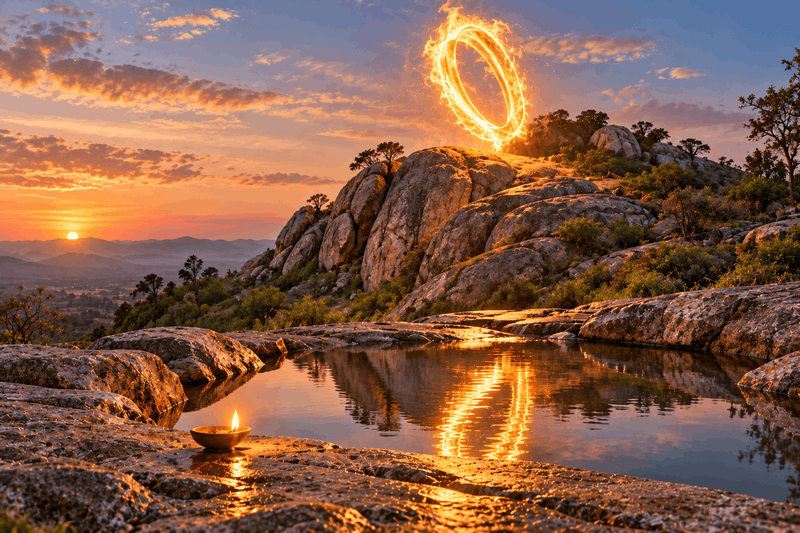
- A speakerin the 2022 newspaper account it vows four lines in its own voice, to turn like a ring of fire here for ever
On where it is, two sites describe a golden chakra about three feet square that glows at the top of the sanctum tower, is visible from some six kilometres and rotates without human help. We found no corroboration for any part of that. What is documented is simpler: a gold chakra finial stood over the vimana and was to be restored after the rebuild.
Tanks, steps and the healing Lord
The Pushkarini is several tanks with several origins, and the sources do not agree whether they are distinct or rebuilt overlaps. One account has the Akasa Ganga flowing into a Vishnu Pushkarini where bathing fulfils wishes. Another says the tank formed from the sage's own ablution water. A third says the sage dug it. Names multiply — Sudarshana Pushkarini, Lakshmi Pushkarini, a Vishnu Kund whose flow is said to come from the deity's feet, Akash Ganga at the lower shrine. The steps have no origin story at all, only the belief that climbing them and worshipping eases knee and joint pain.
The strongest strand of all, and the one that gives the Lord his local by-name, is healing. Vaidya Narasimha, the physician. Tradition holds that devotees are relieved of graha affliction, of trouble from evil spirits and of mental distress, through offerings of fruit, flowers and tulasi theertham; and that for those who believe, the Lord comes in dreams and performs operations. One devotional text speaks of the sick staying a few days on the hill and leaving cured of chronic, painful ailments, many reporting medicines or surgery received in sleep. The common vow is a forty-day mandala pradakshina, with variants at forty-one, forty-five and a month that are probably one practice counted differently.
These should be passed on as exactly what they are: belief, recorded by devotees and temple-side sources. Only one case is ever narrated — a woman declared incurable by doctors who stayed eleven days, saw Narasimha operate in a dream on the eleventh night, and woke recovered. It carries no name, no date and no testing place. One newspaper, in 2017, records the local belief that the deity wards off evil spirits and cures psychological disorders; everything else is temple-side.
The graha material is thinner still. It exists — in the anonymous temple-lore text, in two Telugu outlets, and in a line about Hanuman being worshipped for planetary affliction. But none of them names a planet, and no reliable source links this temple, or Narasimha shrines generally, to relief from any specific graha. It is lore, not a documented remedy tradition, and this collection will not dress it as one.
Swathi
Temple practice treats Swathi as the Lord's birth star here, and a devotee memoir of 2015 records a priest's sankalpam on a Swathi day describing it that way. The same birth-star claim is made at Ahobilam and at Simhachalam.
No scriptural source is cited for it anywhere, and no account explains why Swathi. Narasimha Jayanti itself falls on Vaishakha Shukla Chaturdashi, and the standard reference on that festival does not mention Swathi at all — while one other Narasimha shrine gives a different date again. The observance is well attested. Its basis is not.
What the documents do and do not support about this hill is set out in the record; the five forms the woman is said to have found have an entry of their own.
Reckoning the days
Swathi is the clearest case. It is a nakshatra, it comes round roughly once a lunar month, and whether today carries it is a question with an exact answer rather than an approximate one.
Our panchang app, Navashi, computes that layer for any date and any place: tithi, nakshatra, yoga and karana, the day’s muhurats, choghadiya and hora, and the festival calendar with start and end timings rather than a single date. It carries eight traditions, not one.
- iPhone and iPadNavashi on the App Store
- AndroidNavashi on Google Play