The Being Beneath Every House: The Origin of the Vāstu Puruṣa
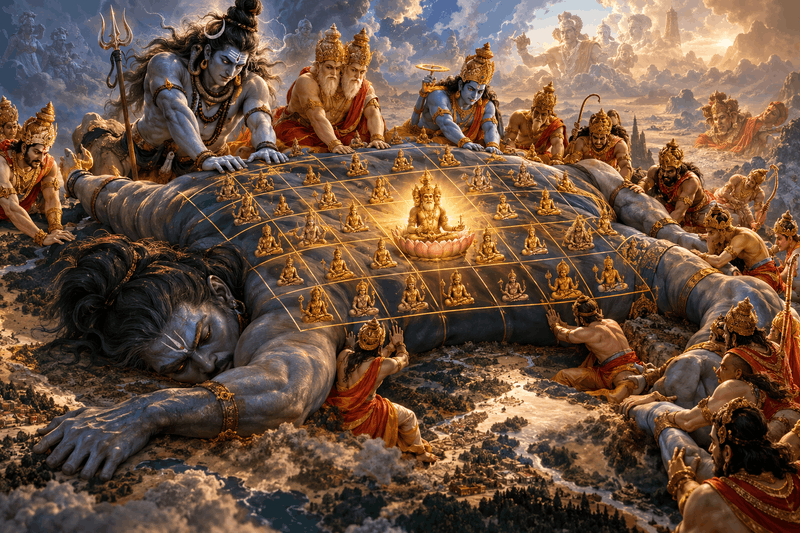
Every plot of land, Vāstu says, has someone lying in it. Before a foundation is dug, a priest invokes him; when a house is finished, he is offered his share. He is the Vāstu Puruṣa, and the forty-five Devtas of the Vāstu maṇḍala sit on his body.
But who is he, and why does he lie there face down? The oldest full answer is not in a Vāstu manual. It is a short, strange story in the Matsya Purāṇa, and it begins on a battlefield.
Born from a god’s sweat
In chapter 252 of the Matsya Purāṇa, Śiva is locked in a fierce fight with the demon Andhaka. In the 1917 English translation, the sweat that trickles from Śiva’s forehead gives birth to “an attendant, grim in appearance, who looked as if to swallow the whole universe with seven islands and the sky.”
The newborn is hungry. He drinks the blood of the fallen demons and is still not satisfied. So he turns to tapas, and in time Śiva, pleased with this strange devotee, offers him a boon.
What would a creature born of battle-sweat ask for? “Lord! be pleased to permit me to eat of the three realms.” And Śiva says: “Be it so.”
Pinned to the earth
Armed with that boon, the being brings all three worlds under his grip, and then falls to earth. Terrified, the Devas, Brahmā, Śiva, the demons and the Rākṣasas surround him and hold him down from every side. Notice who is in that list: it is not the gods alone.
And because the Devas stayed there, living around him, the text says he came to be known as Vāstu Deva.
Pinned and motionless, he complains: how can he stay like this, “with my head downward”? The answer he gets from the gods is the reason Vāstu pūjā exists at all.
What the old story does not say
Read the chapter closely and some of the most repeated “facts” about the Vāstu Puruṣa are simply not there.
- No direction for the head. Chapter 252 says only “head downward”. The north-east head that every modern chart shows is not in this chapter.
- No decree by Brahmā alone. In many retellings Brahmā settles his fate. Here the grant comes from the Devas together.
- No “33 gods and 12 demons”. That neat split is in some modern books, but not in the Matsya, and no classical text found so far states it.
So where did these ideas come from? Some come from other texts, some from modern books, and some have no traceable source at all.
From a body to a blueprint
The next chapter, 253, turns the pinned body into a ground plan. Ten lines are drawn east and ten north, making eighty-one squares, the padas. Forty-five Devtas are worshipped there: thirty-two around the edge and thirteen inside. And at the centre, on nine padas, sits Brahmā, worshipped at the heart: madhye nava pade brahmā hṛdaye sa tu pūjyate.
The same chapter then names a Devta for each limb, from head to feet. Here the texts begin to part company. Who sits at the mouth? Who holds the feet? The Matsya Purāṇa, the Bhavan Bhaskar and the Samarāṅgaṇa-sūtradhāra do not all agree, and in two places the old translation itself looks mistaken.
One being, many stories
The Matsya is not the only telling. Outside it, the story runs along four lines:
- Śiva’s sweat, as in the Matsya, followed by most modern books.
- A nameless great being, seized by the gods with no birth story at all, in the Bṛhat Saṃhitā and the Agni Purāṇa.
- A being born from Śukrācārya’s sacrifice, as the asuras were losing their war with the gods.
- A creature risen from the earth, whom only Viṣṇu could calm.
The texts do not even agree on which way his head points: north in one, east in another, north-east in modern practice, and in one modern book it turns with the seasons. Behind them all stands an older, quieter figure from the Ṛgveda: Vāstoṣpati, the lord of the dwelling.
Where the rest of it is
What the gods promised him in return, and who becomes his food, is where the story turns from myth into practice — it is the reason a Vāstu pūjā is performed at all. That, the full limb-by-limb body map across three texts, and all four tellings side by side, are taken line by line in the 45 Devtas programme: one course for each of the forty-five Devtas of the Vāstu Puruṣa Maṇḍala, in three lessons each, in Hindi.
Every claim there is traced to its source, and where the sources disagree, you see all of them — which, as this chapter shows, is more often than the charts admit.